Overview
This is a one of a kind championship series open to all organizations consisting of 3 contests to compete for one overall championship title. Contest dates are:
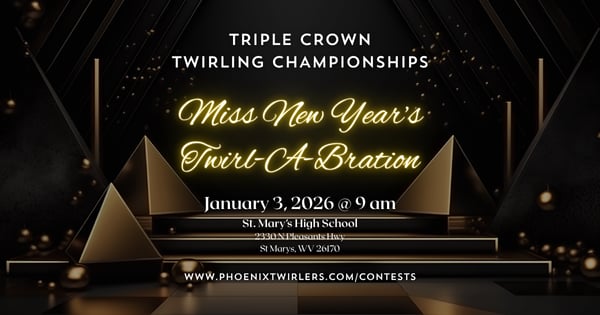
January 3, 2026 - New Years Twirl-A-Bration
February 21, 2026 - Miss Twirlentine
March 21, 2026 - Miss St. Patrick's Day
Points earned from each contest will be tallied together at the end of the 3rd contest to name the TRIPLE CROWN TWIRLING CHAMPION in each age division and in teams!
This is an excellent warm up for IBTF qualifiers as well as State & Regional contests coming up this season.
Each contest offers a full open contest & pageant as well as team competition. Beautiful large awards as well as cash prizes are available!
Come help us start the 2026 twirling season with a bang in beautiful St. Marys, WV!
Amenities
-
Concessions
-
High ceiling
St. Marys High School offers a generous 31 foot ceiling height.
-
High Point Award
High point award for the day will be given in each age division at each contest.
-
Locker room access
Locker rooms are available directly off the gym.
-
Music
Individual and team music must be emailed to [email protected] no later than the Wednesday prior to the contest.
-
Separate practice area
St. Marys offers a double gym featuring a beautiful contest floor with a large warm up gym adjoining it making it easy to keep an eye on the contest as you warm up.
-
Theme and decorations
Each Triple Crown Championship contest features a holiday theme and offers decorations and awards geared to that theme.
-
Unique awards
Beautiful large pageant trophies are given at each contest. Overall TRIPLE CROWN TWIRLING CHAMPIONS will receive a large rotating gold cup trophy, a T-shirt with their title on it, a banner and a $100 cash prize!
Schedule
Awards
Cancellations and Refunds
Rules
Individual Offerings
Open Events
-
Open Dress Modeling
$12.44
Description
Modeling is an event focused on poise and grace, requiring the athlete to demonstrate good balance, correct posture, and a pleasant demeanor while walking in a costume, short dress, or floor-length dress (depending on age and skill level). Sometimes the athlete must give an interview as well. All modeling events are performed in a "Circle T" pattern: the routine begins directly in front of judge, then may turn either direction, left or right, at top of lane before proceeding to a chosen corner. From there, the contestant executes an arc/semi-circle (away from judge) to the opposite corner. Then, the contestant returns to center front of judge’s table and walks back to the starting point. Timing and judging end there. If an interview is included, it is not timed and should be limited to 2 questions. The contestant will wait for the judge’s signal to approach table for the interview. The judge will score first 3 captions before interview begins. The element of the interview should encourage contestant to talk about themselves; their hopes, dreams, goals, and opinions. Contestants are judges on their ability within the style, rather than the style itself. That is to say, all modeling styles within the bounds of good taste will be given equal consideration. Required attire for Novice/Beginner/Intermediate Circle-T modeling and other model-type events is twirling costume or strutting costume. Athletes who do not comply with be disqualified. Advanced contestants at open competitions may wear gowns or costumes, whatever the contest decides.
Pricing
$12.44
Base price: $10.00
Twirlmate fee: $2.44Divisions
Beginner
Advanced
-
Fancy Best Appearing
$12.44
Description
Costume modeling
Pricing
$12.44
Base price: $10.00
Twirlmate fee: $2.44Divisions
Novice
Beginner
Advanced
-
Open Basic Strut
$12.44
Description
Basic Strut requires the athlete to march in a square pattern with no added footwork or legwork. The athlete carries the baton in a traditional or cradle position. Forward motion is mandatory. Judging criteria include: - appearance - posture - gracefulness - timing (staying in step) All styles receive equal consideration (e.g., flourishes while marching or no flourish). The judge may ask athletes to march in a follow-the-leader pattern or one-at-a-time. Athletes may also be asked to change directions, usually marching in a counter-clockwise direction to start and then "reversing" to clockwise.
Pricing
$12.44
Base price: $10.00
Twirlmate fee: $2.44Divisions
Novice
Beginner
Advanced
-
Open Women's Strut
$12.44
Description
Strut, also known as "Fancy Strut", "X-Strut", or "Super X-Strut", is an event deeply rooted in the history and traditions of baton twirling. Athletes perform to march music (or sometimes music of a similar tempo). The routine is composed of march steps, body work (leads, kicks, turns, lunges), and baton work. FLOOR PATTERN Contestants perform individually within the prescribed floor pattern only once. The floor pattern is made up of 5 segments, or "legs". The starting point is at the upper corner of lane to judge’s left. From there, the athlete proceeds diagonally toward opposite corner, turning right at edge of lane. This concludes Leg 1. For Leg 2, the athlete moves straight to opposite edge of lane, turning right. For Leg 3, the athlete travels diagonally to opposite (back) corner and turns left to the center point of lane. Leg 4 is the shortest segment, bringing the athlete to the back center of the floor, directly in front of the judge. Finally, for Leg 5, the athlete turns left and proceeds in a straight line toward the judge. The athlete may finish at any point within the designated 30’ by 20’ lane. Leg 5 shall not extend beyond the borders set by Leg 1. Oblique (side to side) movements are not allowed in first four legs. Retracing/traveling backwards is permitted. BASIC STRUT PORTIONS Legs 1, 2, 3, and 5 must begin with a minimum of four forward consecutive basic march steps. March steps shall be performed immediately after opening salute and on the first steps forward on other specified legs. There is no penalty for exceeding the required minimum four basic steps. TWIRLING Twirling of any kind is not permitted from the first movement to ending salute. This includes rolls, finger work, and baton releases. Only loops, swings and slides are allowed. No more than two continuous revolutions from the center of baton are allowed. The baton must be in a full-hand grip in one hand or another at all times. SALUTE A salute is required at the beginning of the routine, after the opening presentation and before first step forward, as well as at the end of the routine. Timing and judging will begin with the first movement and will end with the final salute. Penalties are assessed beginning with the opening move and therefore will include any violations before the initial salute. Performance shall stop with the final salute and the contestant shall immediately leave the floor. FLOOR CONTACT No part of the body, other than feet, shall contact the floor, either intentionally or unintentionally. TIMING A contestant will receive zero points in timing when out of step on one or more complete legs of the floor pattern or if they are out of step on all required basic steps. In such case, out-of-step penalties shall not count in tabulation. Other captions should still be scored. The contestant will not be disqualified. FREESTYLE SECTIONS When the left foot does not hit the accented beat of the music during freestyle moves, the athlete is not considered out of step. However, the athlete must re-establish proper timing or an out-of-step penalty of .5 will be assessed per infraction. If the contestant does not self-correct within eight counts, an additional .5 penalty will be applied. Only .5 per eight counts of out of step will be assessed. Movements must be on beat with the tempo of the music. An athlete lacking synchronization with the music will receive a lower score in Overall Timing. MUSIC The contest director will provide standard march music for athletes' performances. PENALTIES 1. Standard penalties: drops, falls, unintentional breaks or slips, undertime and overtime, failure to salute, improper salute, intentional contest delay, and using rosin powder on floor. 2. Out of Step: 0.5 per infraction. If the athlete fails to self-correct, an additional 0.5 penalty will be assessed per eight-count. 3. Unauthorized Twirl: 0.5 per infraction. 4. Failure to Perform Basic Steps: 0.5 per floor pattern section. 5. Floor Contact: 0.5 per infraction. 6. Performance after Ending Salute - 0.5 (moving bthe aton from salute to carry position is not considered a violation) 7. Incorrect Floor Patterns - 1.0
Pricing
$12.44
Base price: $10.00
Twirlmate fee: $2.44Divisions
Novice
Beginner
Intermediate
Advanced
-
Open Men's Strut
$12.44
Description
Strut, also known as "Fancy Strut", "X-Strut", or "Super X-Strut", is an event deeply rooted in the history and traditions of baton twirling. Athletes perform to march music (or sometimes music of a similar tempo). The routine is composed of march steps, body work (leads, kicks, turns, lunges), and baton work. FLOOR PATTERN Contestants perform individually within the prescribed floor pattern only once. The floor pattern is made up of 5 segments, or "legs". The starting point is at the upper corner of lane to judge’s left. From there, the athlete proceeds diagonally toward opposite corner, turning right at edge of lane. This concludes Leg 1. For Leg 2, the athlete moves straight to opposite edge of lane, turning right. For Leg 3, the athlete travels diagonally to opposite (back) corner and turns left to the center point of lane. Leg 4 is the shortest segment, bringing the athlete to the back center of the floor, directly in front of the judge. Finally, for Leg 5, the athlete turns left and proceeds in a straight line toward the judge. The athlete may finish at any point within the designated 30’ by 20’ lane. Leg 5 shall not extend beyond the borders set by Leg 1. Oblique (side to side) movements are not allowed in first four legs. Retracing/traveling backwards is permitted. BASIC STRUT PORTIONS Legs 1, 2, 3, and 5 must begin with a minimum of four forward consecutive basic march steps. March steps shall be performed immediately after opening salute and on the first steps forward on other specified legs. There is no penalty for exceeding the required minimum four basic steps. TWIRLING Twirling of any kind is not permitted from the first movement to ending salute. This includes rolls, finger work, and baton releases. Only loops, swings and slides are allowed. No more than two continuous revolutions from the center of baton are allowed. The baton must be in a full-hand grip in one hand or another at all times. SALUTE A salute is required at the beginning of the routine, after the opening presentation and before first step forward, as well as at the end of the routine. Timing and judging will begin with the first movement and will end with the final salute. Penalties are assessed beginning with the opening move and therefore will include any violations before the initial salute. Performance shall stop with the final salute and the contestant shall immediately leave the floor. FLOOR CONTACT No part of the body, other than feet, shall contact the floor, either intentionally or unintentionally. TIMING A contestant will receive zero points in timing when out of step on one or more complete legs of the floor pattern or if they are out of step on all required basic steps. In such case, out-of-step penalties shall not count in tabulation. Other captions should still be scored. The contestant will not be disqualified. FREESTYLE SECTIONS When the left foot does not hit the accented beat of the music during freestyle moves, the athlete is not considered out of step. However, the athlete must re-establish proper timing or an out-of-step penalty of .5 will be assessed per infraction. If the contestant does not self-correct within eight counts, an additional .5 penalty will be applied. Only .5 per eight counts of out of step will be assessed. Movements must be on beat with the tempo of the music. An athlete lacking synchronization with the music will receive a lower score in Overall Timing. MUSIC The contest director will provide standard march music for athletes' performances. PENALTIES 1. Standard penalties: drops, falls, unintentional breaks or slips, undertime and overtime, failure to salute, improper salute, intentional contest delay, and using rosin powder on floor. 2. Out of Step: 0.5 per infraction. If the athlete fails to self-correct, an additional 0.5 penalty will be assessed per eight-count. 3. Unauthorized Twirl: 0.5 per infraction. 4. Failure to Perform Basic Steps: 0.5 per floor pattern section. 5. Floor Contact: 0.5 per infraction. 6. Performance after Ending Salute - 0.5 (moving bthe aton from salute to carry position is not considered a violation) 7. Incorrect Floor Patterns - 1.0
Pricing
$12.44
Base price: $10.00
Twirlmate fee: $2.44Divisions
Novice
Beginner
Intermediate
Advanced
-
Open Women's Solo
$12.44
Description
Solo is the foundation event of baton twirling. It provides a competitor with the opportunity to perform an innovative one-baton routine, adjudicated for its: 1. Variety (20 points) 2. Difficulty (20 points) 3. Speed & Control (20 points) 4. Smoothness & Gracefulness (20 points) 5. Presentation & Showmanship (20 points)
Pricing
$12.44
Base price: $10.00
Twirlmate fee: $2.44Divisions
Novice
Beginner
Intermediate
Advanced
-
Open Men's Solo
$12.44
Description
Solo is the foundation event of baton twirling. It provides a competitor with the opportunity to perform an innovative one-baton routine, adjudicated for its: 1. Variety (20 points) 2. Difficulty (20 points) 3. Speed & Control (20 points) 4. Smoothness & Gracefulness (20 points) 5. Presentation & Showmanship (20 points)
Pricing
$12.44
Base price: $10.00
Twirlmate fee: $2.44Divisions
Novice
Beginner
Intermediate
Advanced
-
Open Collegiate Solo
$12.44
Description
Collegiate Solo showcases how a twirler would perform during a university football halftime show. The routine should demonstrate the athlete’s ability to entertain an entire stadium audience through twirling skills, unique travel sequences, and school spirit, all coordinated with marching band music. Successful routines includes a variety of eye-catching, audience appealing twirls/moves that show up well on the field. Travel steps synchronized with the music are important to ensure total field coverage (this is not a 50-yard line solo). Judges will evaluate performances from a spectator’s point of view. One baton or more batons may be used. Fire, props or novelty items are prohibited, including any piece of equipment or material that is not a baton that can be used or removed, such as glasses, hats, cape, hoop batons, flag batons. Any use of such items will result in a 2.0 penalty. Standard NBTA safety rules apply, except that gymnastics IS allowed. Contestants will enter from the center, place baton(s) quickly, assume an opening pose. MUSIC Marching band music is required, with fight songs encouraged. Music may include an announcer voiceover. Any other music will result in a 2.0 penalty. ELIGIBILITY Women and men will compete together. The highest placed female and the highest placed male at Nationals will receive gender-specific titles. From the finals, the overall highest placing twirler will be named Grand National Collegiate Champion. Collegiate events are open to all contestants who are attending a college, university, or professional school (either full-time or part-time). Twirlers are eligible who have either: - Attending a college or university or professional school - Graduated from high school, have received letter of acceptance, and are enrolled/committed to attend college or university. Athletes must be able to show proof of enrollment or acceptance in order to be eligible. They must also be US citizens to compete in the National Collegiate Championships.
Pricing
$12.44
Base price: $10.00
Twirlmate fee: $2.44Divisions
All Levels Combined
-
Open Two Baton
$12.44
Description
In Two Baton, a contestant performs with two batons and must keep them both moving at all times, either in like patterns or direction, opposing patterns or directions, or in concert with each other. "Like patterns" consist of both batons spinning vertically or horizontally. "Like directions" consist of both batons spinning clockwise or counter-clockwise. "Opposing patterns" consist of one baton spinning vertically while the other spins horizontally, or both batons spinning vertically but perpendicular to each other (e.g., one to the front and another to the side). Both male and female athletes usually compete together, with a few exceptions (such as national championships).
Pricing
$12.44
Base price: $10.00
Twirlmate fee: $2.44Divisions
Novice
Beginner
Intermediate
Advanced
-
Open Three Baton
$12.44
Description
In Three Baton, an athlete twirls and/or juggles 3 batons (no more, no less). A 2.0 penalty will be deducted if more than 3 batons are used.
Pricing
$12.44
Base price: $10.00
Twirlmate fee: $2.44Divisions
Novice
Beginner
Intermediate
Advanced
-
Open Show Twirl
$12.44
Description
Show Twirling is an interpretive, free-style event where athletes perform to their own music and use any mixture of twirling equipment. Props and equipment are limited to what the athlete can carry by themselves in one trip. Electrical or battery-operated props are prohibited, except for lighted batons. Penalty for exceeding prop ruling: 2 points.
Pricing
$12.44
Base price: $10.00
Twirlmate fee: $2.44Divisions
All Levels Combined
-
Open Women's Rhythmic Twirl
$12.44
Description
Sometimes referred to as “interpretative twirling” or “synchronized twirling", Rhythmic Twirl coordinates body movements with personally selected music. Unlike general twirling, in which music is used for background effect, an athlete may vary their baton speed to coordinate with the music. As in other branches of twirling, it’s the "ability within a style and not only the style itself" that is important. All styles of interpretation are acceptable – as long as it's in good taste. ELIGIBILITY - This event is open to advanced solo twirlers only. - Only one baton may be used. - Props are prohibited. PENALTIES - Standard penalties will be applied for drops, falls, unintentional breaks or slips, being under time and over time, intentional delay of contest, and using rosin powder on the floor. AGE DIVISIONS - Men's: 7-9, 10-12, 13-15, 16+. At Nationals, individual age groups may be held, followed by a twirl-off. MUSIC - Individual will select their own music. - Judging begins with the first note of the music and ends with the last note of the music.
Pricing
$12.44
Base price: $10.00
Twirlmate fee: $2.44Divisions
Advanced
-
Open Men's Rhythmic Twirl
$12.44
Description
Sometimes referred to as “interpretative twirling” or “synchronized twirling", Rhythmic Twirl coordinates body movements with personally selected music. Unlike general twirling, in which music is used for background effect, an athlete may vary their baton speed to coordinate with the music. As in other branches of twirling, it’s the "ability within a style and not only the style itself" that is important. All styles of interpretation are acceptable – as long as it's in good taste. ELIGIBILITY - This event is open to advanced solo twirlers only. - Only one baton may be used. - Props are prohibited. PENALTIES - Standard penalties will be applied for drops, falls, unintentional breaks or slips, being under time and over time, intentional delay of contest, and using rosin powder on the floor. AGE DIVISIONS - Men's: 7-9, 10-12, 13-15, 16+. At Nationals, individual age groups may be held, followed by a twirl-off. MUSIC - Individual will select their own music. - Judging begins with the first note of the music and ends with the last note of the music.
Pricing
$12.44
Base price: $10.00
Twirlmate fee: $2.44Divisions
Advanced
-
Open Artistic Twirl
$12.44
Description
Pricing
$12.44
Base price: $10.00
Twirlmate fee: $2.44Divisions
All Levels Combined
In-State Events
-
In-state Men's Strut
$12.44
Description
Strut, also known as "Fancy Strut", "X-Strut", or "Super X-Strut", is an event deeply rooted in the history and traditions of baton twirling. Athletes perform to march music (or sometimes music of a similar tempo). The routine is composed of march steps, body work (leads, kicks, turns, lunges), and baton work. FLOOR PATTERN Contestants perform individually within the prescribed floor pattern only once. The floor pattern is made up of 5 segments, or "legs". The starting point is at the upper corner of lane to judge’s left. From there, the athlete proceeds diagonally toward opposite corner, turning right at edge of lane. This concludes Leg 1. For Leg 2, the athlete moves straight to opposite edge of lane, turning right. For Leg 3, the athlete travels diagonally to opposite (back) corner and turns left to the center point of lane. Leg 4 is the shortest segment, bringing the athlete to the back center of the floor, directly in front of the judge. Finally, for Leg 5, the athlete turns left and proceeds in a straight line toward the judge. The athlete may finish at any point within the designated 30’ by 20’ lane. Leg 5 shall not extend beyond the borders set by Leg 1. Oblique (side to side) movements are not allowed in first four legs. Retracing/traveling backwards is permitted. BASIC STRUT PORTIONS Legs 1, 2, 3, and 5 must begin with a minimum of four forward consecutive basic march steps. March steps shall be performed immediately after opening salute and on the first steps forward on other specified legs. There is no penalty for exceeding the required minimum four basic steps. TWIRLING Twirling of any kind is not permitted from the first movement to ending salute. This includes rolls, finger work, and baton releases. Only loops, swings and slides are allowed. No more than two continuous revolutions from the center of baton are allowed. The baton must be in a full-hand grip in one hand or another at all times. SALUTE A salute is required at the beginning of the routine, after the opening presentation and before first step forward, as well as at the end of the routine. Timing and judging will begin with the first movement and will end with the final salute. Penalties are assessed beginning with the opening move and therefore will include any violations before the initial salute. Performance shall stop with the final salute and the contestant shall immediately leave the floor. FLOOR CONTACT No part of the body, other than feet, shall contact the floor, either intentionally or unintentionally. TIMING A contestant will receive zero points in timing when out of step on one or more complete legs of the floor pattern or if they are out of step on all required basic steps. In such case, out-of-step penalties shall not count in tabulation. Other captions should still be scored. The contestant will not be disqualified. FREESTYLE SECTIONS When the left foot does not hit the accented beat of the music during freestyle moves, the athlete is not considered out of step. However, the athlete must re-establish proper timing or an out-of-step penalty of .5 will be assessed per infraction. If the contestant does not self-correct within eight counts, an additional .5 penalty will be applied. Only .5 per eight counts of out of step will be assessed. Movements must be on beat with the tempo of the music. An athlete lacking synchronization with the music will receive a lower score in Overall Timing. MUSIC The contest director will provide standard march music for athletes' performances. PENALTIES 1. Standard penalties: drops, falls, unintentional breaks or slips, undertime and overtime, failure to salute, improper salute, intentional contest delay, and using rosin powder on floor. 2. Out of Step: 0.5 per infraction. If the athlete fails to self-correct, an additional 0.5 penalty will be assessed per eight-count. 3. Unauthorized Twirl: 0.5 per infraction. 4. Failure to Perform Basic Steps: 0.5 per floor pattern section. 5. Floor Contact: 0.5 per infraction. 6. Performance after Ending Salute - 0.5 (moving bthe aton from salute to carry position is not considered a violation) 7. Incorrect Floor Patterns - 1.0
Pricing
$12.44
Base price: $10.00
Twirlmate fee: $2.44Divisions
Novice
Beginner
Intermediate
Advanced
-
In-state Men's Solo
$12.44
Description
Solo is the foundation event of baton twirling. It provides a competitor with the opportunity to perform an innovative one-baton routine, adjudicated for its: 1. Variety (20 points) 2. Difficulty (20 points) 3. Speed & Control (20 points) 4. Smoothness & Gracefulness (20 points) 5. Presentation & Showmanship (20 points)
Pricing
$12.44
Base price: $10.00
Twirlmate fee: $2.44Divisions
Novice
Beginner
Intermediate
Advanced
-
In-state Women's Strut
$12.44
Description
Strut, also known as "Fancy Strut", "X-Strut", or "Super X-Strut", is an event deeply rooted in the history and traditions of baton twirling. Athletes perform to march music (or sometimes music of a similar tempo). The routine is composed of march steps, body work (leads, kicks, turns, lunges), and baton work. FLOOR PATTERN Contestants perform individually within the prescribed floor pattern only once. The floor pattern is made up of 5 segments, or "legs". The starting point is at the upper corner of lane to judge’s left. From there, the athlete proceeds diagonally toward opposite corner, turning right at edge of lane. This concludes Leg 1. For Leg 2, the athlete moves straight to opposite edge of lane, turning right. For Leg 3, the athlete travels diagonally to opposite (back) corner and turns left to the center point of lane. Leg 4 is the shortest segment, bringing the athlete to the back center of the floor, directly in front of the judge. Finally, for Leg 5, the athlete turns left and proceeds in a straight line toward the judge. The athlete may finish at any point within the designated 30’ by 20’ lane. Leg 5 shall not extend beyond the borders set by Leg 1. Oblique (side to side) movements are not allowed in first four legs. Retracing/traveling backwards is permitted. BASIC STRUT PORTIONS Legs 1, 2, 3, and 5 must begin with a minimum of four forward consecutive basic march steps. March steps shall be performed immediately after opening salute and on the first steps forward on other specified legs. There is no penalty for exceeding the required minimum four basic steps. TWIRLING Twirling of any kind is not permitted from the first movement to ending salute. This includes rolls, finger work, and baton releases. Only loops, swings and slides are allowed. No more than two continuous revolutions from the center of baton are allowed. The baton must be in a full-hand grip in one hand or another at all times. SALUTE A salute is required at the beginning of the routine, after the opening presentation and before first step forward, as well as at the end of the routine. Timing and judging will begin with the first movement and will end with the final salute. Penalties are assessed beginning with the opening move and therefore will include any violations before the initial salute. Performance shall stop with the final salute and the contestant shall immediately leave the floor. FLOOR CONTACT No part of the body, other than feet, shall contact the floor, either intentionally or unintentionally. TIMING A contestant will receive zero points in timing when out of step on one or more complete legs of the floor pattern or if they are out of step on all required basic steps. In such case, out-of-step penalties shall not count in tabulation. Other captions should still be scored. The contestant will not be disqualified. FREESTYLE SECTIONS When the left foot does not hit the accented beat of the music during freestyle moves, the athlete is not considered out of step. However, the athlete must re-establish proper timing or an out-of-step penalty of .5 will be assessed per infraction. If the contestant does not self-correct within eight counts, an additional .5 penalty will be applied. Only .5 per eight counts of out of step will be assessed. Movements must be on beat with the tempo of the music. An athlete lacking synchronization with the music will receive a lower score in Overall Timing. MUSIC The contest director will provide standard march music for athletes' performances. PENALTIES 1. Standard penalties: drops, falls, unintentional breaks or slips, undertime and overtime, failure to salute, improper salute, intentional contest delay, and using rosin powder on floor. 2. Out of Step: 0.5 per infraction. If the athlete fails to self-correct, an additional 0.5 penalty will be assessed per eight-count. 3. Unauthorized Twirl: 0.5 per infraction. 4. Failure to Perform Basic Steps: 0.5 per floor pattern section. 5. Floor Contact: 0.5 per infraction. 6. Performance after Ending Salute - 0.5 (moving bthe aton from salute to carry position is not considered a violation) 7. Incorrect Floor Patterns - 1.0
Pricing
$12.44
Base price: $10.00
Twirlmate fee: $2.44Divisions
Novice
Beginner
Intermediate
Advanced
-
In-state Women's Solo
$12.44
Description
Solo is the foundation event of baton twirling. It provides a competitor with the opportunity to perform an innovative one-baton routine, adjudicated for its: 1. Variety (20 points) 2. Difficulty (20 points) 3. Speed & Control (20 points) 4. Smoothness & Gracefulness (20 points) 5. Presentation & Showmanship (20 points)
Pricing
$12.44
Base price: $10.00
Twirlmate fee: $2.44Divisions
Novice
Beginner
Intermediate
Advanced
Visitor Events
-
Visitor Women's Strut
$12.44
Description
Strut, also known as "Fancy Strut", "X-Strut", or "Super X-Strut", is an event deeply rooted in the history and traditions of baton twirling. Athletes perform to march music (or sometimes music of a similar tempo). The routine is composed of march steps, body work (leads, kicks, turns, lunges), and baton work. FLOOR PATTERN Contestants perform individually within the prescribed floor pattern only once. The floor pattern is made up of 5 segments, or "legs". The starting point is at the upper corner of lane to judge’s left. From there, the athlete proceeds diagonally toward opposite corner, turning right at edge of lane. This concludes Leg 1. For Leg 2, the athlete moves straight to opposite edge of lane, turning right. For Leg 3, the athlete travels diagonally to opposite (back) corner and turns left to the center point of lane. Leg 4 is the shortest segment, bringing the athlete to the back center of the floor, directly in front of the judge. Finally, for Leg 5, the athlete turns left and proceeds in a straight line toward the judge. The athlete may finish at any point within the designated 30’ by 20’ lane. Leg 5 shall not extend beyond the borders set by Leg 1. Oblique (side to side) movements are not allowed in first four legs. Retracing/traveling backwards is permitted. BASIC STRUT PORTIONS Legs 1, 2, 3, and 5 must begin with a minimum of four forward consecutive basic march steps. March steps shall be performed immediately after opening salute and on the first steps forward on other specified legs. There is no penalty for exceeding the required minimum four basic steps. TWIRLING Twirling of any kind is not permitted from the first movement to ending salute. This includes rolls, finger work, and baton releases. Only loops, swings and slides are allowed. No more than two continuous revolutions from the center of baton are allowed. The baton must be in a full-hand grip in one hand or another at all times. SALUTE A salute is required at the beginning of the routine, after the opening presentation and before first step forward, as well as at the end of the routine. Timing and judging will begin with the first movement and will end with the final salute. Penalties are assessed beginning with the opening move and therefore will include any violations before the initial salute. Performance shall stop with the final salute and the contestant shall immediately leave the floor. FLOOR CONTACT No part of the body, other than feet, shall contact the floor, either intentionally or unintentionally. TIMING A contestant will receive zero points in timing when out of step on one or more complete legs of the floor pattern or if they are out of step on all required basic steps. In such case, out-of-step penalties shall not count in tabulation. Other captions should still be scored. The contestant will not be disqualified. FREESTYLE SECTIONS When the left foot does not hit the accented beat of the music during freestyle moves, the athlete is not considered out of step. However, the athlete must re-establish proper timing or an out-of-step penalty of .5 will be assessed per infraction. If the contestant does not self-correct within eight counts, an additional .5 penalty will be applied. Only .5 per eight counts of out of step will be assessed. Movements must be on beat with the tempo of the music. An athlete lacking synchronization with the music will receive a lower score in Overall Timing. MUSIC The contest director will provide standard march music for athletes' performances. PENALTIES 1. Standard penalties: drops, falls, unintentional breaks or slips, undertime and overtime, failure to salute, improper salute, intentional contest delay, and using rosin powder on floor. 2. Out of Step: 0.5 per infraction. If the athlete fails to self-correct, an additional 0.5 penalty will be assessed per eight-count. 3. Unauthorized Twirl: 0.5 per infraction. 4. Failure to Perform Basic Steps: 0.5 per floor pattern section. 5. Floor Contact: 0.5 per infraction. 6. Performance after Ending Salute - 0.5 (moving bthe aton from salute to carry position is not considered a violation) 7. Incorrect Floor Patterns - 1.0
Pricing
$12.44
Base price: $10.00
Twirlmate fee: $2.44Divisions
Novice
Beginner
Intermediate
Advanced
-
Visitor Men's Strut
$12.44
Description
Strut, also known as "Fancy Strut", "X-Strut", or "Super X-Strut", is an event deeply rooted in the history and traditions of baton twirling. Athletes perform to march music (or sometimes music of a similar tempo). The routine is composed of march steps, body work (leads, kicks, turns, lunges), and baton work. FLOOR PATTERN Contestants perform individually within the prescribed floor pattern only once. The floor pattern is made up of 5 segments, or "legs". The starting point is at the upper corner of lane to judge’s left. From there, the athlete proceeds diagonally toward opposite corner, turning right at edge of lane. This concludes Leg 1. For Leg 2, the athlete moves straight to opposite edge of lane, turning right. For Leg 3, the athlete travels diagonally to opposite (back) corner and turns left to the center point of lane. Leg 4 is the shortest segment, bringing the athlete to the back center of the floor, directly in front of the judge. Finally, for Leg 5, the athlete turns left and proceeds in a straight line toward the judge. The athlete may finish at any point within the designated 30’ by 20’ lane. Leg 5 shall not extend beyond the borders set by Leg 1. Oblique (side to side) movements are not allowed in first four legs. Retracing/traveling backwards is permitted. BASIC STRUT PORTIONS Legs 1, 2, 3, and 5 must begin with a minimum of four forward consecutive basic march steps. March steps shall be performed immediately after opening salute and on the first steps forward on other specified legs. There is no penalty for exceeding the required minimum four basic steps. TWIRLING Twirling of any kind is not permitted from the first movement to ending salute. This includes rolls, finger work, and baton releases. Only loops, swings and slides are allowed. No more than two continuous revolutions from the center of baton are allowed. The baton must be in a full-hand grip in one hand or another at all times. SALUTE A salute is required at the beginning of the routine, after the opening presentation and before first step forward, as well as at the end of the routine. Timing and judging will begin with the first movement and will end with the final salute. Penalties are assessed beginning with the opening move and therefore will include any violations before the initial salute. Performance shall stop with the final salute and the contestant shall immediately leave the floor. FLOOR CONTACT No part of the body, other than feet, shall contact the floor, either intentionally or unintentionally. TIMING A contestant will receive zero points in timing when out of step on one or more complete legs of the floor pattern or if they are out of step on all required basic steps. In such case, out-of-step penalties shall not count in tabulation. Other captions should still be scored. The contestant will not be disqualified. FREESTYLE SECTIONS When the left foot does not hit the accented beat of the music during freestyle moves, the athlete is not considered out of step. However, the athlete must re-establish proper timing or an out-of-step penalty of .5 will be assessed per infraction. If the contestant does not self-correct within eight counts, an additional .5 penalty will be applied. Only .5 per eight counts of out of step will be assessed. Movements must be on beat with the tempo of the music. An athlete lacking synchronization with the music will receive a lower score in Overall Timing. MUSIC The contest director will provide standard march music for athletes' performances. PENALTIES 1. Standard penalties: drops, falls, unintentional breaks or slips, undertime and overtime, failure to salute, improper salute, intentional contest delay, and using rosin powder on floor. 2. Out of Step: 0.5 per infraction. If the athlete fails to self-correct, an additional 0.5 penalty will be assessed per eight-count. 3. Unauthorized Twirl: 0.5 per infraction. 4. Failure to Perform Basic Steps: 0.5 per floor pattern section. 5. Floor Contact: 0.5 per infraction. 6. Performance after Ending Salute - 0.5 (moving bthe aton from salute to carry position is not considered a violation) 7. Incorrect Floor Patterns - 1.0
Pricing
$12.44
Base price: $10.00
Twirlmate fee: $2.44Divisions
Novice
Beginner
Intermediate
Advanced
-
Visitor Women's Solo
$12.44
Description
Solo is the foundation event of baton twirling. It provides a competitor with the opportunity to perform an innovative one-baton routine, adjudicated for its: 1. Variety (20 points) 2. Difficulty (20 points) 3. Speed & Control (20 points) 4. Smoothness & Gracefulness (20 points) 5. Presentation & Showmanship (20 points)
Pricing
$12.44
Base price: $10.00
Twirlmate fee: $2.44Divisions
Novice
Beginner
Intermediate
Advanced
-
Visitor Men's Solo
$12.44
Description
Solo is the foundation event of baton twirling. It provides a competitor with the opportunity to perform an innovative one-baton routine, adjudicated for its: 1. Variety (20 points) 2. Difficulty (20 points) 3. Speed & Control (20 points) 4. Smoothness & Gracefulness (20 points) 5. Presentation & Showmanship (20 points)
Pricing
$12.44
Base price: $10.00
Twirlmate fee: $2.44Divisions
Novice
Beginner
Intermediate
Advanced
Pageant
-
Twirl-A-Bration Pageant
$42.31-62.90
Description
All pagants will follow NBTA format and tabulation guidelines, however are open to all organizations and any gender. Novice pageant contestants will compete in costume modeling with NO INTERVIEW, Basic Strutting and 1 baton solo.
Pricing
$42.31-62.90
Base price: $35.00-55.00
Twirlmate fee: $7.31-7.90Divisions
Novice
Beginner
Intermediate
Advanced
Duet Offerings
Duet Events
-
Duet Show Twirl / Artistic Twirl Pair
$11.41 per-person
Description
Pricing
$11.41 per-person
Base price: $10.00
Twirlmate fee: $1.41Divisions
All Levels Combined
-
Open Duet
$11.41 per-person
Description
A Duet consists of two contestants performing at the same time. The pair is judged on their ability to twirl in unison or a complimentary fashion with one another while exchanging batons.
Pricing
$11.41 per-person
Base price: $10.00
Twirlmate fee: $1.41Divisions
All Levels Combined
Team Offerings
Team Events
-
Open Dance Twirl Team
$4.20 per-person
Description
A Dance Twirl team consist of four or more members. The team's performance is accompanied by recorded music of their choice, and should be creative in choreography as well as costume. Creativity is achieved through musical interpretation, combining movement with expression and baton. Strong routines include an introduction, dynamic effects, a conclusion and a theme. Dance steps should be coordinated with the music, bringing together beauty of leg work, footwork, and body work with the baton. The routine must have combinations of baton and dance. Space should also be used and designed properly, ensuring proper coverage of the floor. All forms of dance may be used: ballet, modern, lyrical, jazz, Irish, flamenco, country, disco, Charleston, etc. Gymnastics IS allowed. The primary goal in Dance Twirl is to deliver a routine made up of continuous dance steps while twirling and maintaining a consistent degree of difficulty. TIME LIMIT Minimum of two minutes, maximum of three minutes. Timing begins with the first movement on introduction of music and ends with the last movement or conclusion of music, whichever comes first. When the exit is performed with music, timing continues until the last member crosses the boundary line or the music ends, whichever comes first. MUSIC - Teams may choose their own music. - Dance Twirl team director is responsible for the quality of his/her team’s music (including volume) - Dance Twirl teams may use their own sound equipment or equipment provided by the contest - Should a power failure occur during a team’s performance, the team will have a choice of continuing from when the power went out or starting over from the beginning - Teams must test their music prior to competition - Excessive volume can result in a penalty of not less than 2.0 points nor more than team disqualification (discretion of the chief judge and contest director applies) DANCE TWIRL TEAM-SPECIFIC RULES Entrance - Teams will enter the floor, with or without music, from the far boundary line directly across from the judge’s table. - A team may position themselves anywhere they choose on the competition floor before the music starts. - Teams entering the floor without music will be noted but not scored. Exit - A Dance Twirl team will exit to the judge’s right to leave the competition floor, with or without music - Teams exiting the floor without music will exit to judge’s right immediately following the last note of music. This exit will be noted but not scored. Batons - Intentional grounding of the baton not allowed. Penalty will be the same as drop. "Grounding" is the placement of a baton such that it is out of team member possession and could remain so without danger of moving or changing position indefinitely. CRITERIA 1. Twirling (20 points) 2. Dancing (20 points) 3. Production (20 points) 4. Technique and quality of performance (20 points) 5. Appearance, showmanship, presentation (20 points)
Pricing
$4.20 per-person
Base price: $3.50
Twirlmate fee: $0.70Divisions
All Levels Combined
-
Open Twirling Team
$4.20 per-person
Description
A Twirling Team consists of four or more members, each twirling one baton in unison accompanied by the NBTA INTERNATIONAL music. The primary goal in Twirling Teams is a routine with an entrance, variety in twirling, exchanges, changing in floor patterns and an exit within the time allowed. TIME LIMIT Minimum of two minutes, maximum of three minutes. Timing begins with a leader salute on the starting line (back boundary line) and ends with a leader salute on the finish line (back boundary line). The leader may take no more than four basic marching steps off the back boundary line for the opening and closing salute. MUSIC Performances will be accompanied by the NBTA INTERNATIONAL march music. World Team music will be used for all Junior and Senior Teams in Preliminary and Final Rounds. When using World Team Music, teams may start on the competition floor and end on the competition floor. Salute is still required. TWIRLING TEAM-SPECIFIC RULES - Starting line/Finish line: The far boundary line directly across from the judge’s table. - Novelty batons/items or additional batons may not be used, as that is considered a Half-Time Show Twirl Team. - Each Twirling team member must enter competition floor with baton in hand. CRITERIA 1. Twirling (20 points) 2. Teamwork (20 points) 3. Production (20 points) 4. Technique and quality of performance (20 points) 5. Appearance, showmanship, presentation (20 points)
Pricing
$4.20 per-person
Base price: $3.50
Twirlmate fee: $0.70Divisions
All Levels Combined
-
Open Novelty Team
$4.20 per-person
Description
Requires no twirling
Pricing
$4.20 per-person
Base price: $3.50
Twirlmate fee: $0.70Divisions
All Levels Combined
-
Open 1/2 Time Show Twirl Team
$4.20 per-person
Description
A Half-Time Show Twirl Team has four or more members and uses recorded music of their choice. The ultimate goal in a Half-Time Show is a routine with a high entertainment value for audiences at school athletic events and other community functions. The choreography of the routine should provide today's youth with educational show training experience. Thus, athletes will learn to give an impressive performance to the general public. To fulfill the requirements for a Half-Time Show Twirl Team, 50% of its members must twirl some type of twirling equipment at the same time at some point within the performance. Example twirling equipment includes a baton or color guard equipment such as flags, rifles, or sabers. Any props or equipment with entertainment value is acceptable as part of a Half-Time Show Twirl routine. Examples include: - Pom pons - Ribbons - Ropes - Hats - Canes - Chairs - Ladders - Stools - Scarves - Umbrellas - Balls, etc. Gymnastics IS allowed. All forms of dance may be used as well: ballet, modern, lyrical, jazz, traditional dances from other countries, clogging, disco, rock and roll, etc. SPECIAL NOTE: A single baton by itself used by all members throughout the performance is considered a Dance Twirl team routine. If a team performs a Dance Twirl team routine in Half-Time Show Twirl team competition, they will receive only 10 points in routine content, teamwork, and production captions on score sheet. No placement award shall be given. Half-time Show Twirl team categories include: - Routine Content (20 points) - Teamwork (20 points) - Production (20 points) - Technique and quality of performance (20 points) - Appearance, showmanship, presentation (20 points)
Pricing
$4.20 per-person
Base price: $3.50
Twirlmate fee: $0.70Divisions
All Levels Combined
-
Open Pom Pom Team
$4.20 per-person
Description
Halftime Show Pom Pon Teams are made up of 4 or more members, and must display the ability to use pom pons with precision and grace. For maximum audience appeal, choreography should combine changing floor patterns, group designs, and dance steps. SPECIAL EFFECTS AND PROPS 1. Props are prohobited. 2. A 2.0 penalty will be enforced if part of a costume is removed during a performance and used as a prop (example: cape, hat, glasses, scarves). This penalty will be assessed only one time, regardless of how many members are using props. GENERAL RULES 1. The Pom Pon team is allowed to ground pom pons during any part of the routine, but the use of pom pons is necessary to fulfill the requirements of the routine. JUDGING CRITERIA 1. Routine Content (20 points) 2. Teamwork (20 points) 3. Production (20 points) 4. Technique and quality of performance (20 points) 5. Appearance, showmanship, presentation (20 points)
Pricing
$4.20 per-person
Base price: $3.50
Twirlmate fee: $0.70Divisions
All Levels Combined
-
Open Dance Line
$4.20 per-person
Description
Pricing
$4.20 per-person
Base price: $3.50
Twirlmate fee: $0.70Divisions
All Levels Combined
